Showing posts with label Aleksandra Kozlova-Harris. Show all posts

Friday, November 20, 2009

48 Hour Media Log

My 48 Hour Media Log:

Wednesday, November 18,2009:
Watched news while eating breakfast and saw commercials between news reports.
Checked facebook, saw ads on the side columns.
Yahoo! mail had ads for checking one's credit score, rich dad education, and auto insurance.
Watched Psych episode with commercials.
Searched Google for statistics information and saw related ads on sidebar.

Thursday, November 19, 2009:
Watched news with commercials while eating breakfast.
Checked facebook and saw ads on the side.
Checked Yahoo! and saw news stories about various celebrities.
Saw Google ads related to chemistry.

*This media log is rather limited due to the amount of time spent studying for various tests and completing assignments due the week prior to Thanksgiving break. A typical week would include more interaction with media.*

Friday, November 6, 2009

Traditional Rituals - Long Essay


This counts for one of my longer essays.
I have come to understand that a ritual is a rite of some sort, be it a rite of passage or a religious ceremony of some sort whereas a tradition is a belief, custom, or legend that is passed down throughout the generations. The interconnectedness of the two terms combined with the religious ties that both definitions refer to inspired me in revitalizing a tradition that died within my family three generations ago.
My maternal great-grandparents were both Belorussian Jews who immigrated to Moscow to escape the ghetto system of life and for better work opportunities. They secured positions in an airplane manufacturing company that relocated to Siberia in order to evade the Nazi threat to Moscow during World War II. The rest of their respective families weren’t so lucky: my great-grandpa and one sister were the only living members of a 10 children household and my great-grandma was the sole survivor of her 19 siblings. Bitterness from their families’ pointless deaths combined with the (then) Soviet Union’s anti-religion policy caused my ancestors to abandon all religious aspects of their Judaism – they became atheists.
The atheistic tradition continued on until my mother got baptized into the Seventh-day Adventist Church. We attended church regularly and we were glad for the strong community and theological foundation of the church, yet there was still something missing and that something turned out to be rooted in the tradition and heritage that my great-grandparents left behind, our Jewish heritage. My family and I have decided to keep the feasts in an attempt to have a closer walk with God and to continue the ritual that got cut off as an indirect result of the Holocaust and communism.
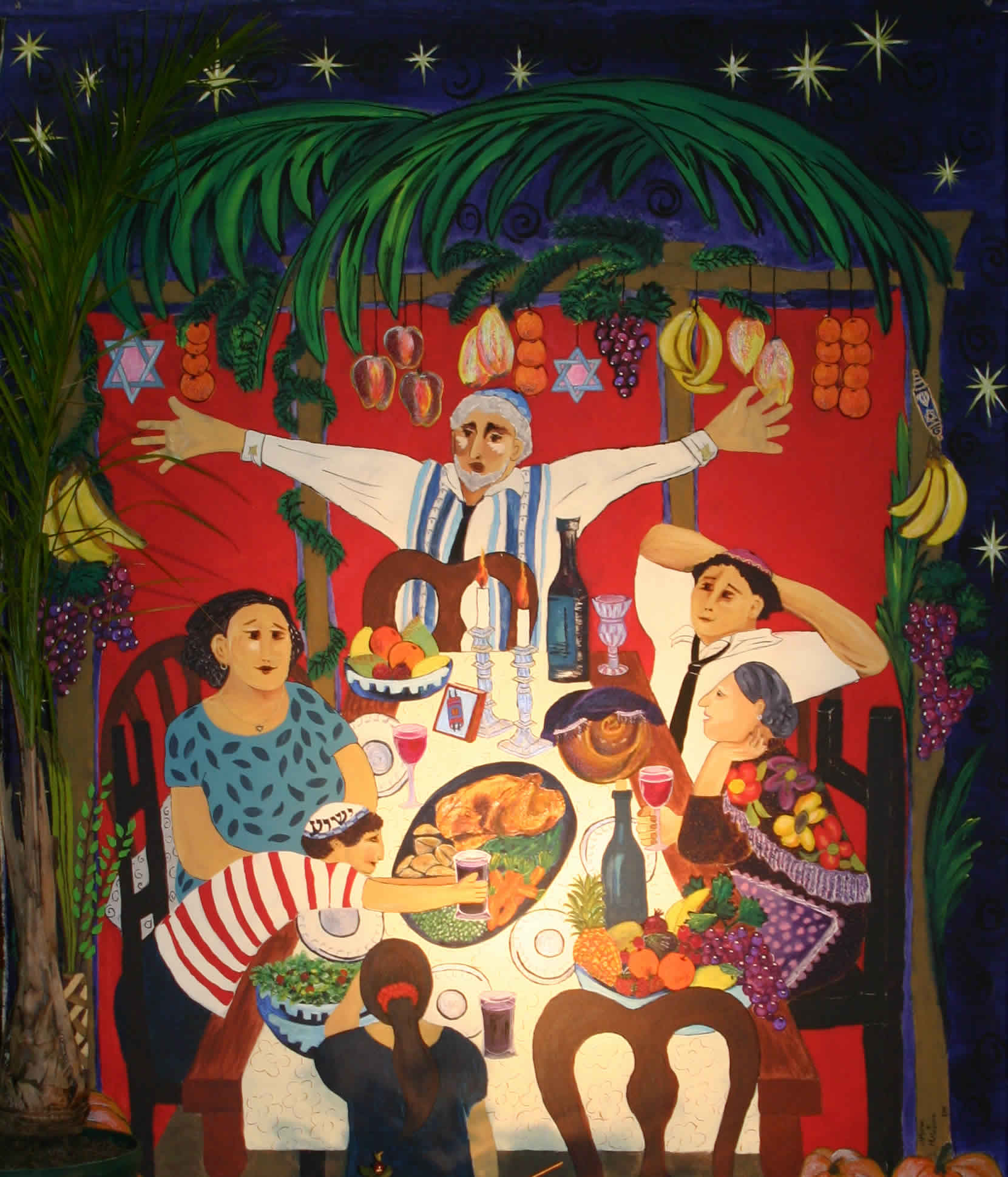
One such feast is Sukkot, the Festival of Booths. This is a ritual that has been embedded into the fabric of my family’s life and one that I intend to keep and pass on through the generations. Sukkot is a festival of celebration in which all the people live in temporary dwellings, commemorating the Israelites’ time of wandering in the desert. This feast is a celebratory holiday following Yom Kippur, the Day of Atonement.
While Sukkot does call for a citron, a date palm branch, willow twigs, and myrtle twigs, little else is needed. It is not a commercial holiday by any means of the word – its intent is to go out to celebrate with Yahweh, to reconnect with one’s creator and sustainer. The holiday is a wilderness experience, a time to celebrate the completion of atonement, of remembering God’s love for His people, whom He guided safely through the wilderness. To me, Sukkot is a time of drawing near to God and family, it is not based in gift-giving and commercialism. The feasts are going to be one ritual that can bring my loved ones together and draw each one of us nearer to God.

Monday, November 2, 2009

Google: A Model for the Future?

If someone (other than a math major) today read the word “googol” in a paper or on a sign, they would most likely shrug their shoulders and laugh at the uninformed person who misspelled Google, the wellspring of information portals. Yet the Google enterprise based its name off of that word; a mathematical term for 1100. Now the word Google has morphed into a proper noun, a word that spell check capitalizes; the word brings up images of a white screen with the blue, red, green and yellow letters informing one that he or she has arrived at the fountainhead of search portal destination.
Google’s mission is a unique one: “to organize the world’s information and make it universally accessible and useful” (http://www.google.com/intl/en/corporate/). From their foundation till today, their focus hasn’t changed; Google is still dedicated to their users. Google has set up Google Chrome to make searching ever simpler and Google Books, in order to digitize information that is not yet available on the web. Google is doing all it can think of to make its search engine faster, simpler, and more effective to its users.
Google is also unique in its advertising technique: Google set up its site so that advertisers bid for their ads to be attached to certain keywords in an open auction, thus making the ads on Google pertinent to the individual’s searches. Google has also opted to separate their search results from the ads of sponsoring companies by putting the two categories under separate headings – making it easier to find what one is looking for directly without having to sift through a myriad of ads.
Not only does Google make searching simple, it also aids in social networking and long distance communication/cooperation. Gmail and Google Docs are set up to benefit collaboration between people in various geographical areas by allowing everyone in a certain group to work on the same set of data via these Google applications. Google is dedicated to be the most user-friendly, fast, and most available information portal that it can be – in fact, one of Google’s “Ten Things” is “it’s best to do one thing really, really well”, which is reflected in their success as a search engine.
Google believes that “you can make money without doing evil” and that “democracy on the web works” – Google strives to develop and improve its site in all aspects without doing injury to its users or compromising its mission statement (http://www.google.com/intl/en/corporate/tenthings.html). Google’s new outlook of businesses attempting to cater to individuals’ needs and attempting to aid the customer to the greatest extent possible is becoming the goal of a growing number of companies.
This may change consumerism and the economy in the next ten years from one of attempting to get the consumer to need or want the product a company is selling to attempting to make a product that a consumer wants or needs. Companies may shift their focus towards making products geared toward individual interests and needs – custom-made products may become the common commodity. One never knows what the future may bring, but Google seems to be paving the way towards a more client friendly version of economics and consumerism.

Friday, October 23, 2009

Getting Off Our Fannies - A Perusal of The Acumen Fund & Entrepreneurship

"I want to make this world good. Not better, but to make it good. Why not? It is possible. Look around in this room -- all this knowledge, energy, talent, and technology. Let's get off our fannies, roll up our sleeves and get to work, passionately, in creating an almost perfect world" - these are the words of Isabel Allende, a speaker for the TED (Technology, Entertainment, Design) Conference (http://dotsub.com/view/32444fb9-72f7-4996-b826-27d1c0a9e491/viewTranscript/eng). The TED Conference's mission is "ideas worth spreading" (http://www.ted.com/pages/view/id/5). TED is a non-profit organization that people such as Isabel Allende and Seth Godin are a part of. I was immensely impressed with Ms. Allende's quotation - for no matter where one stands on the liberal/conservative scale, regardless of one's opinion on how much people should get involved in which organization, I believe that we all agree the world is messed up and needs fixing. There is no perfect solution; nor are we even remotely close to a consensus on what needs to be changed, but people are striving, in some small way, to get involved and add their contribution to making the world a better phrase, to borrow the oft-used phrase.
This is precisely what the Acumen Fund and its promoters (Seth Godin, for one) are attempting. The concept of supporting innovative entrepreneurs to change the economic backbones of their countries is brilliant. I have had my doubts and worries about how much welfare truly helps those at home and abroad. Do the funds truly help give people the financial boost they need in hard times or does it take away their independence and the independence of subsequent generations? I don't have an answer to that question, but I feel much more enthusiastic in backing a plan which allows the creativity and hard work of ingenious minds to pave a path for the financial development of struggling countries. All in all, I am curious to read and hear more about the Acumen Fund and entrepreneurs such as Seth Godin, who have the bravery, will, and desire to try something few of us are willing to attempt.

Thursday, October 8, 2009

A Late Night Contemplation of Energy Expenditure

Late nights are a useful, often essential part of a college student’s career. There’s always that one essay that sneaks up, or that test that one isn’t prepared for, so the body’s limits are pushed yet again in the presence of the ever-growing to-do pile. Unfortunately, I have become familiar with the wee transition hours between night and day. At some point in the night, the concentration and drive breaks down and the mind wanders down all forms of rabbit trails. One such rabbit trail led me to an innovative, although not yet practicable, idea for energy usage in the home.


Green solutions for homes, buildings, and other architectural infrastructure are immensely prevalent right now; a new branch of architecture has sprung up for just such demands. This made my brainstorm for unique environmental solutions quite difficult indeed. Ideas of solar powered appliances, distributing recycling bins to coffee shops, and green roofs all went out the window with Google search: most had already been implemented. So much for original ideas, but then a thought struck me. What if everyone had an energy gauge in their homes, an interactive gauge in the living room that could tabulate how much water, gas, heat, et cetera was used each day.

Not only would the gauge calculate the consumed energy, it would equalize and minimize the amount of energy used. For instance, if water was left on in the kitchen for say, 15 minutes, the water would automatically shut off (but could be overridden by the homeowner via pressing a manual override button that would take that particular appliance off of automatic mode for a time). The same would happen with certain electronics, such as television, radio, computers, and appliances, including microwaves, stoves, and the like. In this way practically every source of energy consumption in the home could be shut off if one doesn’t pay attention to the amount of water running while brushing one’s teeth, or by forgetting to shut off the television.

I don’t know how feasible this idea is at this current moment, if at all. I am not sure if the technology for such an innovation is currently out there, or if the cost of such a machine would be within homeowners’ economic reach, I simply believe that an energy gauge that kept track of energy expenditure when the human brain is too busy with other things, would be a good idea. I’m not suggesting that energy ought to be partitioned and that everything shuts off if a house overrides the goal energy consumption for that day, which would be inconvenient and frustrating. I am simply proposing that having an innovation with the task of knowing a home’s energy consumption might improve efficiency and reduce wastefulness in homes the nation, if not the world, over.

Friday, October 2, 2009

Direct Service

Humans are social beings that thrive on love, friendship, and connections with fellow beings in general. It is part of our nature to have passions and areas of interest in which we invest our time, money, and effort. Many people have a passion for, or at least an interest in service of some form; some organization or cause that they feel they ought to back. But is financial support enough? Can one truly give back to the community in a purely monetary manner? I think not. Dr. Karl Bailey and his associates in the Behavioral Sciences Department of Andrews University conducted a study on religiosity and their results showed that high cost behaviors (such as tithing, fasting, being an elder, active involvement of some sort) resulted in greater happiness than those that simply attended.
Similarly, Bill McKibben brings up the Waltons of Walmart fame, who on the top tier of the financial pyramid “runs a budget deficit and can’t afford a new sewage treatment plant” in the town of Bentonville, Arkansas, the birthplace of the Walmart industry (pg.124). One of McKibben’s statistics stated that Americans who make between $50,000 and $100,000 give “two to six times as much of their money (in percentage terms) as people who make more than $10 million” (pg.124). These wealthy people that donate money at such low percentages don’t get involved in the organizations and programs that they financially support. If one doesn’t get involved in high cost behaviors, then one is not as vested in the programs as much.
People are wired to interact with one another, to help each other out, and to push themselves in areas that they are interested in/passionate about (otherwise no one would ever get a college degree, the effort wouldn’t be worth it), but if people aren’t involved in face-to-face service, it is hard to become passionate about a cause or program. Unless one has first-hand personal experience, the cause isn’t real to them. I’m not saying that there is no room for financial contribution, because without money virtually nothing can function. Also, a person may have multiple causes they are interested in helping, but one can’t feed people in Somalia, take care of orphans in Russia, and teach literacy in El Salvador simultaneously; few people have the time to dedicate years of their lives to service, and that is fine. One can contribute financially to those organizations, but I believe that it is essential to our well-being, and our Christian calling to change the world around us in some small way, for service is a truly selfless calling.

Friday, September 25, 2009

Thanksgiving: Pilgrims and Indians Revised - Long Essay


A photo of my mother and grandmother-The Russian Side of my Family

This counts for one of my long essays.

Thanksgiving Day brings to mind a day of feasting, table(s) heaped with turkey, tofurky, stuffing, mashed potatoes, gravy, and the ever-present pumpkin pie. Except the pumpkin pie wasn’t present that Thanksgiving, nor was much else on the “traditional Thanksgiving menu. My mother and I immigrated to the United States from Russia when I was seven, leaving all friends and relations behind. In her loneliness for her daughter and granddaughter, my grandmother visited us one Thanksgiving. It was my family’s turn to host the Thanksgiving festivities and through a series of odd events, the only person available to cook for the Thanksgiving meal was my grandmother. My mother began the day by cooking mashed potatoes, turkey, and throwing together a salad, but the majority of the Thanksgiving preparation was left to my grandmother, who had been in America a grand total of two weeks and had never heard of a Thanksgiving celebration, much less observed one.
As the afternoon progressed, my grandmother busied herself preparing borscht, cranberry salad, Russian potato salad, and all manner of delicious ethnic desserts. She spent hours preparing her best-loved delicacies for my immediate family and my stepfather’s family. There was only one problem: the plates she prepared didn’t fall under the “traditional” Thanksgiving food plan. So when the entire Harris clan herded into the dining room, there was a moment of awkward silence. The food placed before the children was dubbed as “weird” and everyone looked skeptically about the room as my grandmother waited in anticipation for all to try her offering of love.
Once the prayer of thanks had been uttered, each member (save the Russian extension of the family) sampled the new Thanksgiving fare. As it should be with all days of celebration, the food turned out wonderfully and the day was spent in humorous companionship and enjoyment. That Thanksgiving was the best, most profound holiday I have ever had, for it was the last time that I saw my grandmother and that was the day I found the true meaning of holidays and family. Because the food laid out on the table didn’t matter (even though it was DELICIOUS and none of us could move an inch after consuming copious amounts of it), what mattered was my family’s readiness to accept my grandmother’s heritage and her attempt to celebrate our new culture. No matter what the plan is or what the expectations for a particular celebration are, the things that make a holiday a day of joy is the company and love surrounding a family. For what greater blessing can one be grateful for on Thanksgiving than a loving family and a good life.

Friday, September 11, 2009

Common Wealth: Attainable or Impeded by Selfishness?

Jeffrey Sachs’ book felt like a coded message to solve the world’s problems with one missing component: the correct key. Not that I mind his book, I actually believe that he summarized the world’s problems up in a more succinct and clear way than I have ever experienced. Mr. Sachs has done an excellent job in researching and identifying all that is amiss with our world, but I find his solutions very unsatisfactory.
Mr. Sachs focuses a great deal of attention on the government’s role in kick-starting the eradication of poverty, the leveling off of world population, and conservation of natural resources. While this is all well and good, to which governments is he referring? There are few countries in the world (especially in today’s current economic slump) that either have the ability or the desire to spread that kind of wealth around.
I agree that most people don’t mean to be selfish or uninvolved with those suffering in other regions, but it is also true that we spend very little of our time researching the socioeconomic and political climates of our neighbors near and far. I know that I am guilty of not being well enough informed and don’t help out those in bloody coups or civil wars as I ought. I am simply wondering what it will take for upper class people to give up their daily coffee, or doughnut, or their yearly vacations in order to give that money to others. I wonder what it will take for the leading, non third world governments to stop trying to give their citizens everything they want, to stop worrying about reelections and instead concentrate on policies that will radically change not only their nation, but the world.
It’s going to take a lot more than a few activists that really believe in change, it’s going to take a lot more than everyone thinking that it’s a good idea. Some of the best and wisest are known for their ideas, but those ideas didn’t accomplish anything by just being in the minds of scholars. Those ideas only led to change when they became burning, living & breathing convictions in the hearts and souls of the people. As of yet, I don’t see that happening. I see a lot of people going about life not thinking about anything outside of their tiny microcosm. That may be cynical, but that’s what I see (for the most part). I believe it’s going to take something big to happen before people are ready and willing to change and improve upon the points Mr. Sachs mentioned in his book. But when people are willing to lay self aside to change (if that’s even completely possible in a suffering, sinful world), they will make the change happen and the government will follow suit, not the other way around.