LinkedIn © 2011, LinkedIn Corporation
LinkedIn © 2011, LinkedIn Corporation
LinkedIn I'd like to add you to my professional network on LinkedIn.
- Jean  | Jean Lemeau
2011 Alumni of Andrews University
Benton Harbor, Michigan Area | Confirm that you know Jean © 2011, LinkedIn Corporation 
Please let me know ASAP if you'd like your materials - papers, projects, etc. - returned to you. If so, I'll leave them in the Honors office. Thanks!
Hello All! I hope you are having safe travels and are looking forward to a Merry Christmas and a Happy New Year!
A consulting client is developing plans to offer several internships in 2011. The organization is a well-known not-for-profit operating in the health care and chronic disease space. Chicago/West Loop location.
Many details remain to be worked out, but duties would focus on website redesign and on developing a social media and marketing strategy to help the organization build customer relationships and prepare for the impact of health reform.
Please e-mail me if you are interested in learning more details as they become available.
Unlike many of my peers, I focused on the economic and social challenges that communities face rather than the environmental and emotional aspects. I am sure that many people today are living in communities that have seen a steady decline at the aid of loans from other communities. For those who wish to truly live in an environment in which the word independent is in the air that they breathe I would suggest they live here. Do not misunderstand this as a prejudice place or one that is native only. This is mainly for those who wish to thrive in a commonwealth that can be proud of its achievements and the lack of ties or enslavement to the wills of other places.
NOTE: I am in Chicago this morning (Dec 8) for meetings and may be late getting back for the "final exam." Feel free to e-mail your documents to me (steve@t1resources.com). Or, turn them in at Dr. Pittman's office and I'll pick them up. Or, wait for me in the classroom. I'll be there, just probably a little late. Pass the word. Thanks!
“Don’t judge a book by its cover.” I would take this well-known statement and tweak it a little: “Don’t judge a class by your friends’ experiences.” At the beginning of the year, I did not have high expectations for this class. Many of my friends warned me about it, even suggested that I drop the class and take a different Honors elective, but a part of me wanted to see what was the cause of all the discontentment. I can now say that it was well worth it to stay in the class; many of the lessons that I learned this year came from this course. Many of the topics covered in class were interesting and applicable, but the one that impacted me the most was the video by Randy Pausch. I believe that as we grow older, we tend to complicate things. Money, love, fame, status, all these things skew our dreams; when we are younger, our dreams are unaffected by these materialistic things. With our naïve, innocent natures, many of the goals that we have are, in essence, selfless. If we want to be doctors, it’s because it looks cool or we want to save the lives of our dolls; if we want to be mailmen, it’s because we get along with dogs and enjoy walking around; from the small to the big, our decisions and desire are unmarred by the typical acquisitive mindset. Ask most teenagers what they want to do and the answer will come back tinged with a desire to gain money and status or the desire to be nonconformist. Gone is the desire to change the world: instead of asking what they can do for others, they ask what others can do for them (borrowing from the JFK speech). I know that it is said that children are selfish because they don’t know better, but sometimes it seems like they know more. As we grow older, we take the very simple and change it to the very obscure. To change the world, we must first change ourselves. To even change ourselves, we must know who we are. As Veblen states, “we are social animals”. A lot of our value and personal definition comes from the way we are perceived by others. Many of our actions are done with the questions: “will others see me doing this?” and “what will they think?” resounding in our minds. One of the most important, yet hardest, changes to make is to the way that we think. I believe that in order to realize this balance between achieving our dreams and helping others, we need to accept the contradictions that might arise. I am of the firm conviction that a person who is doing what they are passionate about, be it collecting trash, cleaning the sewer, performing neurosurgery, or teaching a room full of bratty college students, if they are passionate, they will make a more lasting and meaningful mark than if they are doing it for ulterior motives. When I was little, I loved watching the show E.R. My sister was addicted to the show, so by default (I enjoyed mimicking my sisters, down to their likes and dislikes), I was addicted to the show as well. I loved watching the doctors. Blood, open wounds, vomit, these things did not scare me. The more I saw, the more I wanted to be a doctor. I guess I had a hero complex; I wanted to save lives, I wanted to help families, I wanted to know that every day was a success. As I got older, when people asked me what I wanted to do and I told them doctor, their immediate response was to say, “Oh, that’s a good profession. You’ll make a lot of money.” The first time that I heard that was from my aunt. When she told me that, I responded, “Really? I’ll make a lot of money?” The idea was foreign to me. Since no one in my family was a doctor, I did not know of the status or money that comes with the profession. After a while, I found myself explaining to people that I didn’t want to be a doctor because of the money or status that I would get with the title, but because I was truly passionate about helping people and knowing that I made an impact on someone’s life. One of the reasons that I want to be a Pediatrician is so I can get back in touch with the child in me. They approach many of the biggest problems with an unbiased opinion. My hope is that the time spent with them will help me see the world through less tainted glasses. Maybe this is a naïve thought, but I believe that if we are more satisfied with who we are and what we are doing, then we won’t feel the need to buy everything that is in sight. We could befuddle advertisers, stop escaping our reality by watching “reality” shows, and actually spend time with our families. It feels like the children these days are deprived of the fondest memories that I have, such as running around during the summer, jumping through sprinklers, actually knowing the neighbors, family dinners, and much more. In ten years, when we ask the 7-12 year olds of right now what they remember about their childhood, all they will see is a big, fat T.V. screen/iPod/Wii. So how will I live? I am still not quite sure how my life will unfold, but I want to be remembered for my passion, for my love, and for my desire to help others. I don’t want my name to be known by a lot of people. My dad is known throughout the Romanian Seventh-Day Adventist community, and while that may not sound like it is a big deal, there are a lot more Romanian Adventists than you think there really are. I have seen how frustrating it can be to have people constantly approaching him with questions, asking him to break up disputes, and even say that my father is not fit to be a pastor. I feel as though being known is not so much a blessing as it is a burden. If I am to be known, I would prefer being known intimately by few people, but I want the influence that I have on them to cause them to be in influence on others. Just like the movie “Pay It Forward”, every little action has a resounding effect. In context with what we’ve learned in class, I want to live in such a way that the Earth does not remember me for what I’ve done to it. It is a matter of making small changes that have a large cumulative impact. By simply unplugging what I’m not using, turning off unnecessary lights, and using mass transportation when I’m at home in New York City, I can help reduce some of the burden that is being put on our planet. After what we learned about in this class concerning advertising, I felt a little used by the system. The manipulative nature of the business is nothing new, but find out how impressionable we truly are is somewhat concerning. I hope that by knowing myself, who I really am, and knowing what I need and want, I will be able to avoid the consumerism that engulfs this country. Maybe the solution to our problems is just that simple: knowing who we really are, what we really want, and how to find the balance between what we need and want. But simple as these words may sound, it will take a lifetime to actually get an answer to these questions. That is how I shall live: I shall live striving to know myself and to use that knowledge to help others.
Class is canceled today (Monday the 29th.) Sorry, I can't get a flight back until tomorrow. See you Wednesday.
We'll plan on making the project presentations more like 2-3 minutes each, so plan accordingly.
Please pass the word. Thanks!
What separates my ideal community from most is its relative size. My utopia will be relatively small. This will help in making everything within walking or biking distance as well as uniting the community. What is most important about my utopian community is the emphasis on unity. My community will not just be a group of people living within the same vicinity, it is an establishment of people working together for the greater good. While this may sound cliche at first, one will find that my community is one in which all find happiness and security. A normal neighborhood is full of mutual strangers. No one takes the time to get to know each other on a personal level. Very few neighbors can actually consider themselves friends. In my community everyone will know each other. Every weekend there is a community activity in which all community members get to know each other and enjoy some relaxation to further build bonds. On the first Monday of every month, there is a community board meeting in which issues are brought to the attention of the board by the members of the community. This allows everyone's voice to be heard if some local problems or disputes arise between members. Interestingly enough, advertisement of my community will not be entirely necessary. The best form of advertisement is word-of-mouth. It is not only free, but it is the most credible because it is coming from a friend.
Besides the strong emphasis on unity within the community, an emphasis will also be put on amenities and landscape. Landscaping will not be uniform for each house, as in a subdivision. Rather, each home owner will be allowed to design their landscape according to their own tastes. It will not have the bland monotony of a normal subdivision. Several playgrounds and pools will be available to members, as well as a fitness center within walking distance. A community center will have stores, shops, and entertainment facilities.
More important than the amenities is the ethical practices which will be applied to all aspects of the community. My utopia will be one of principle, emphasizing ethical business practices and respect for community members. Thus, the law enforcement will be minimal in my community, however it will be present in case of emergency situations.
Everyone seems to long for an “escape from reality”. My community makes that escape from reality, a reality. The aspect of my community that will first grab your attention is the aesthetic aspect. Let’s be honest, we all like things that look good. Somewhere between my communities luscious greenery, litter-free streets, refreshingly pure air, and friendly atmosphere you’ll find yourself feeling that your current community is a tad inferior. But the real selling point of my community is that it goes beyond surface appeal. In the midst of economic turmoil, we manage to isolate ourselves as much as possible from the outside world and we are able to maintain an steady, semi-independent, economy. Grocery stores are provided for by in-community resources. We have our own factories, manufactories, agriculture, and so on. These resources not only provide jobs for our community members (and our community members only), but they also allow us to control our own prices. Only community members are given special community prices. Outsiders that stop by to shop in our out-of-community shops only further benefit our economy. The biggest problem convincing people to live in my community is the extensive application process. You see, in this community there is virtually no crime or murder. In order to maintain these standards there are extensive background checks done on each individual that applies to be a member of the community. We only want to be sure that we can provide the safest environment for our members to raise their children in. The thing is, once someone sees what my community has to offer, they usually find that the benefits far outweigh all else. Also, we don't need to advertise our community; word of mouth takes care of that for us.
-Phil Giddings
Think back to the movie Pleasantville. The world seemed perfect. There were firemen who never had to put out a fire, the basketball team never missed a basket, and no matter how much butter there was on the pancakes they never gained a pound. When you look past the superficial layer of the town, there was one thing about that neighborhood that everyone watching the movie longed for, and that was a sense of community. In the movie, as people would walk down the street it was certain that they would see someone they knew. There was never a worry because there was always someone looking out for you. Now think back to your current neighborhood. Do you sometimes feel like your neighbors decide to turn their music up around the time you decide to go to sleep? Maybe your neighborhood is quiet, but you do not know the people walking past you every morning? For those of you who do know your neighbors do you feel like there are not activities that bring the community together? The recently established Brownsville addresses these issues and more. Realizing that this is the 21st century and people like to have their personal space, the homes in the neighborhood are not close together. There is a large amount or lawn space allowing you to either sit and enjoy the scenery or invite your neighbors over. The center of the town is in the midst of all the houses. The park, schools, stores and offices are within walking distance of each other. This not only encourages people to interact with each other, but it also lessen the amount or carbon produced by cars. When the day is all said and done you are able to retreat to your homes with your families or go to the park to hear a concert with a few friends. Of course each community would have its problems and that is why we’ve set up a town hall forum that is in the center if the town so that if someone has a problem they can go to the town hall to discuss it. If the problem is within a smaller group such a block of homes, there is a block association that would be able to help solve the problem. If there is a problem with your children at school, we have staff available to meet with you when it best fits you so that our children can get the best of their education. Think back on men such as Ben Carson and Thomas Aquinas. When Ben Carson was younger he did not do well in school, in fact many of his teachers wrote him off as stupid. However, Ben went on to go to Yale and became a well-known neurosurgeon. The same for Thomas Aquinas, when he was in the university, he never answered any of his teachers’ questions. His nickname was the Dumb Ox. However, whenever someone misspoke about a particular philosophy, Thomas Aquinas was the first to correct them. Aquinas became known as one of the most influential theologians of the Church. All great things have a rough beginning and that is why we have programs set up to help ease the transition as the community gets built up even stronger.
When ideal meets reality, conflict inevitably arises. It is not difficult to dream up an ideal community. But it becomes a nearly impossible task when we try to make it work. The first challenge that I had was deciding how open my community should be. I don’t want my community to be some sort of an exclusive club. But In order for my ideal community to work, I need people who would want to live by the ideal of my community. And in order to keep our community ideal, I would need to screen out people who do not fit. My community cannot grow indefinitely. So, rather than advertising about the physical place, I want to spread the way of life that my community embraces. People can adopt the philosophies and ideals of my community and start their own, and my community will serve as a model to which other communities can learn and immediate. Adopting the philosophies of my community requires a change in heart. As I write it, I don’t know if I could fit into this community. The ideal of helping others and sharing may be intellectually sound but really desiring to live in the community is a different matter. Also, voluntary participation is hard to achieve. I don’t want to have any laws in my community. I want people to do what is right for themselves and their neighbors. All these require people becoming selfless, which would literally be going against human nature and is impossible. To convince people to live in my community or live like our community, I first need to persuade people to be less selfish and that spending their lives trying to accumulate wealth is futile. I also need people to be thankful in small things and find happiness in life itself. For people who are fully satisfied with the way they live, my “advertisement” would not mean much. But for people who have experienced dissatisfaction and emptiness in the way we live, my message will be a good news. Whether my place will be better than typical American community is depended on one’s standard. For people who enjoy buying lavish things and have no interest in a communal way of living, my community will probably the worst place to live. But for people who know how to be appreciative of small things and enjoy interaction with neighbors, my community will be the ideal for them as well. As I was writing my plan, I realized that I’m sort of copying what God did. Christianity is all about community, and God wanted humans to live in a certain way. Israel, although with many flaws, was chosen to be the ideal that other nations could see and follow. It wasn’t so much their geographical location that made this community special. It was the relationship this community had with God, and through that relationship, the relationship between people became special. Moses was a visionary who preached the way a community of God should live. But for some Israelites, the concept was hard to grasp and some preferred the way they lived as slaves. In a way, we are becoming a slave to large companies and the system we created. Through constant advertisements, we are being trained to spend more money and be dissatisfied. We are in this continual cycle where we work hard to buy something and work even harder to buy something else. This doesn’t necessary have to be the way we live. We can change it and we should change it.
Live in an environmentally sustainable community—a community that thrives on the ideas and practices that surround the act of lowering carbon dioxide emissions. Live in a community that lives exactly as that—a community: one that values history, community, fellowship, its responsibility to the earth, and its “coolness factor”. Live in a community that believes and practices the phrases “re-use” and “re-purpose” without sacrificing aesthetics. Many environmentalists use scary, “Armageddon-like” descriptions of our future world and explain how our environmental irresponsibility will destroy us. However true these descriptions might be, what if we used a different way to convince people to care and to change. Could we make an environmentally sustainable life attractive, or even “cool”? My community would be one that attracts its members through “buzz”. If “buzz” works for so many other products—why not use it to work for a radically different way of life? Exploring the benefits of my community through the different areas of media would be the typical way to create a following or a fan base. However, my community would first be marketed to a niche group of individuals with a sure-fire belief in my community’s standards of living. As with most “cool” things—it would be important to create a lifestyle that would cause a stir and a significant amount of intrigue. By narrowing to a niche group, a form of exclusivity would be created and, in turn, that exclusivity factor would generate want. The next step would be to appeal to the masses in a slow, calculated way that would convince them that they, too, could live the life offered in a community such as mine. As with anything being sold or advertised, my community must be seen as better than what is already in place. If I can convince people to live a better life, why not do it using cool tactics and not scare tactics?
It cannot be denied that the activity of Human species on Earth has greatly upset the equilibrium in the delicate ecology of our planet. Al Gore had made it plain in his lecture "An Inconvenient Truth" that our actions are greatly responsible for most of the anomalies of the planet's climate. In this sense, each and every one individual is responsible for preserving the environment in which we exist. We do not need anymore apocalyptic movies to remind us of the consequence of our overlooking the problems we are facing, nor do we need to actually endure one to learn the lesson. Our would is at a brink of destruction due to our actions, and the inconvenient data presented by environmental scientists are not mere applications for someone's business model to increase revenue. In fact, the slogan of Going Green must not be just another actualization of some clever business model to increase private corporations' profit. It must be an awareness for every individual member in the Homo Sapiens species. As the crises is imminent, it takes more than a small change in our lifestyle to preserve our environment. As such, I have envisioned a community that will live according to the ideal of preserving the planet and will train our future generation to act responsibly. This community is designed with welfare of human beings in mind, by promoting a healthy and environmentally responsible lifestyle. The premise of the community is intentionally designed to be inaccessible for non-essential vehicles, to encourage a healthy amount of exercise and at the same time to ensure the safety for children within. The facilities will be constructed with environmentally friendly materials and methods. The local economy will be one that does not put stress upon the land. It is essential for each human beings to understand that we have owed much to our landlord, and we must take up responsibility to pay the debt. Choosing to live in this community is a tremendous commitment to repay our debt, which everyone of us is entitled to. In doing so, our landlord may choose to renew the lease, to grant us our continual existence.
I would first like to remind people what my community entails. It is a place where people have to live on enough land to provide food for themselves in the event of an economic crisis rendering it impossible for them to purchase goods of nutritional sustenance. This society also seeks to find renewable sources for energy. In the short-term, the residents would use fossil fuels but would then transition to power made available through other resources as they become available (assuming that these individuals have not yet made the change in energy source themselves). I would also encourage those living in this settlement to have efficient heating systems given that our settlement occupies the latitudes of New England (i.e. modern and efficient wood stoves that could provide heat to emanate throughout the house). The community is part of an already-established municipality with a government that utilizes town hall meetings and offers opportunities for civic engagement. My community is also Christian in nature. Thus, it is a place where people resolve their disputes with their neighbors using the principles found in Matthew 18. How would I attract people to this settlement? I would begin by purchasing a large plot of land, informing the municipality of my intention to convert it into a residential area governed by the principles that I outlined. The first people I would seek to attract would be my family and friends; they know who I am, share similar principles, and might actually desire to live in this sort of community. I would then seek to find others who are ecologically-friendly and Christian who would be attracted to this way of life. To do this, I would advertise that the community has the potential for being self-sustaining in agricultural production and that it is actively seeking alternative energy sources. I also think it would be prudent to invite the members of the town to our community to have a meet-and-greet. Perhaps I can promote my community on this occasion. One thing people will be looking at is the attractiveness of the homes that are in the settlement. I would want the architectural designs to be somewhat uniform to denote the fact that these are private residences that are somehow linked together. Another question I must address is the possibility that my ideas may not work in practice. What would happen if nobody desired to be a part of my community? I would have to sell the purchased land and try another idea. I cannot account for all possible problems that may arise. However, as in the case of Thomas Edison inventing the lightbulb, success is not always achieved right away. It takes work. When we speak of these utopian communities, we must remember that change in society can be seen as the cumulative actions of individuals. I am convinced that the growth of my settlement will depend on shared values and a town's willingness to have the existence of this enclave in their territory of land. I believe that if social mingling is encouraged, good relations between my community and the municipality of its location would be possible. Written by Bradley Sica
Since my community is really a community within a community (being as it is just one apartment building in the middle of a large city; think NYC or London), the best way to advertise it will be to become involved with those outside the apartment building. A lot of these communities run the risk of being so insulated from the rest of the world that reality becomes distorted. Although I understand escapist tendencies and admit that residing in an insulated utopia sounds much more enticing (and certainly easier) than trying to change our existing superstructure, my community's goal of sustainability is inherently interested in the greater good and stems from a desire to be connected with the larger global community and the environment. Thus, my "ideal" apartment building community in the city - with its solar panels and vegetable garden on the roof - will involve itself heavily in the city life around it in an attempt to include, educate, and inspire the citizenry. This larger community involvement will consist of things like open house days, free urban gardening classes, and hosting for community events such as art galleries and poetry readings in our large street-level lobby. Through inviting the larger community into our small community, we will surely create enough interest that people will want to move in; those who cannot will be given the tools to implement some of our practices in their own homes and apartments. It's not hard to teach people about the environment, and how to make small changes like cutting water and electricity use. If they are really inspired and seem dedicated to environmentally sustainable life, they may apply for an apartment in our building. I like to think that there will be a waiting list. You may sneer, but believe me. There will be a waiting list. 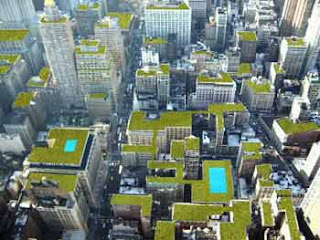 "Focusing your life solely on making a buck shows a certain poverty of ambition. It asks too little of yourself. Because it's only when you hitch your wagon to something larger than yourself that you realize your true potential. " Barack Obama
Based on Maslow's Hierarchy of Needs, after acquiring physiological and safety needs, humans desire social needs. After achieving these basics needs, we then go on to acquire our needs of self-esteem and self-actualization. The average community today overemphasizes physiological and safety needs and avoids confronting the social and personal aspects of life in a community. In my ideal community, all 5 levels of needs will be achieved. It will be a place where family relationships will be the foundation--where people will feel a sense of belonging and protection; where the comfort of a stable, social environment will produce individuals with high self-esteem, confidence, and knowledge. The reason people in my community will prosper is because they will be dependent on each other to motivate and to support. Individuals will occasionally sacrifice their own interests to help with the advancement of others because they know that by helping others, they are improving the state of the whole community. Recycling, reducing waste, car-pooling, etc. will all be activities that families will participate in because they are mindful of the choices that their present actions will make on the future generation. Out of familial love, the young will respect their elders, and elders will do their best to brighten the future for their children.
American society in its current state is obsessed with the present--how can we change things right now? How will it make my life better? My community focuses in on the larger scope--how will we manage carbon emissions, how can we educate our children to be eco-friendly? We will focus on decreasing emissions, therefore lowering utility costs. Also, by having families drive together and eat meals together (locally) a more intimate family bond will form (lowering costs for food and fuel).
The difficult aspect is to make people change their mindset. To be part of a community that actually cares about the future of their planet, and their children, many sacrifices must be made. Although these sacrifices will improve the over all condition of communities, in truth, they are still sacrifices, and people must be willing to make them. Just look at the state of our economy. People remain upset because immediate changes have not been made. Approval ratings for the Obama Administration have declined; people are giving up on change because it is not immediate. Leaders like Ghandi and Martin Luther King Jr. struggled convincing people to participate in civil disobedience. Having people accept a new idea or a new mindset will always be difficult. However, if a small tribe of people who passionately believe in the future of their idea stick to it, change is always possible.
When asked to design my ideal community, the first characteristic that came to mind was sustainability. Ever since I heard Henning Sehmsdorf describe his farm where he practices biodynamic and sustainable farming, the idea has fascinated me. I have always been interested in farming, but it just didn’t seem practical in the modern world. Yet here was a university professor telling me that he runs a sustainable, debt-free farm that produces everything his family needs except for toilet paper, which they pay for from the sale of farm produce. I have dreamed of going and learning how to run a sustainable farm, but what would be even better would be a sustainable community.
There are many benefits to living in a sustainable community. On the top of the list would be improved health resulting from higher quality food and increased exercise. The community would also dramatically reduce its impact on the environment and the farming techniques would improve the land. There would also be an increase in a sense connectedness due to neighbors helping each other farm. All these factors taken together would increase the community members’ levels of satisfaction.
While this community may sound great in my head or on paper, making it a reality is taking it to a whole new level. That is something that I can’t do myself, which may lead me to give up on the idea. However, according to Seth Godin, if I can build a tribe around my idea, than anything is possible. I don’t need to convince the world that my community is the answer to its problems; I simply need to convince 1000 people.
So how do I create a tribe around my idea? Godin proposes four steps that I have seen to be effective for leaders of various movements. The first is to tell a story to people who want to hear it. This step is what I’ve already begun to do in writing this blog. The key is to find 10 people with whom I can share and further cultivate my passion for sustainable farming. These 10 will find another 10 who will in turn find another 10 and voilà, 1000 individuals with a common interest that can link them together. The second step is then to connect these individuals into a tribe based on their desire to practice sustainable farming. How convenient that farming requires teamwork. Humans seek community. We want a place to belong. The idea is to make a tribe that satisfies that desire. Now this tribe needs a leader. This sounded the most daunting to me at first. Telling a story about my passion to people who want to hear it naturally brings people together, but now to lead a movement, that is scary to me. The problem is my concept of leadership. I don’t have to know all the answers or possess all the skills to lead. Rather, I can actually be a more effective leader by recognizing my inadequacies and finding others who excel in those areas. By helping each person to find his or her niche, the area where he or she can shine, I can strengthen the tribe. Now we are ready to take the final step, to make a change. Change is not easy. In fact, overcoming people’s fear of change would be one of the biggest obstacles to making my community a reality. In order to form this community, the members of the tribe would have to reject old unsustainable habits and embrace new, sustainable ones. This would involve learning new skills. They would also have to give up some of the luxuries that we take for granted without considering the environmental consequences of their production. All of the above is possible if one decides that the outcome, a sustainable community, is what they want. There would also be the difficulty of maintaining the community by building a strong internal structure because as the community grows, more and more challenges will present themselves. For this I would rely heavily on talented individuals in the tribe for leadership and support. However, for now my task is to build that tribe and become acquainted with the various strengths of the members.
|
|
|


