Showing posts with label rituals. Show all posts

Sunday, November 15, 2009

Bed Time Ritual

When I was a kid I could not go to sleep without my dad having tucked me in first. I would get in bed after hugging and kissing my family and wait for him to arrive to do the task. I could not fall asleep until it was done and he understood this . So he would swiftly appear and tuck in my sheets and fluff up my pillows. Often times he would tuck in my sheets so tight that I could not move, but that was how I liked. Once he was done he would give me a kiss goodnight an turn off my light, leaving my door just wide enough so I could see a sliver of light from the hall. It was a ritual of many years, one (I must admit) I recently grew out of.
I think back upon it now and I can’t help but wonder its importance. My father tucking me in was not the essential key to my sleeping, it was the mere fact that I had created a world where his tucking me in was the key. It was a ritual that made me feel comfortable, together, safe and at home. While I was growing a and experiencing new things around me in school and my community, this was a ritual that kept me sane and comfortable. I believe that is where rituals do their part. They help one feel as though they are in control, and consequently this makes them more comfortable with life. Now today I have other rituals that make me feel better about life. All of them helping me to feel in control.

Friday, November 6, 2009

The Duality of Rituals

As a child, I was very strict about making sure everyone kept our family traditions. There must be candles, soup, and a tablecloth for Friday night. Every week night, I must be tucked in by my mother and she must read me a story, sing me a song, kiss me and say "Night, night. Sleep tight. Don't let the bedbugs bight. See you in the morning. I love you." My father was not allowed to tuck me in unless in emergency situations when my mother wasn't at home and then he knew exactly one song to sing which was: "Into My Heart." and he would sing exactly two verses of that song. And both of them would leave my door slightly open with the hall light on.

As I've grown older, those and even the more sacred and important Christmas and Thanksgiving traditions adapted or fell by the way side. For the last several years, for instance, we haven't had our traditional, ritualisitc, family Thanksgiving dinner, but have instead opted to meet at my Aunt's house. (Since I only get a lousy four day holiday which wouldn't be enough to come home.)

But I'm not complaining. The slow evolution of rituals is natural and good. It means you are growing and the rituals must change to suit your new needs. As I grow older, I've adopted new rituals. For example, every Saturday morning, I attempt to eat a chocolate-sundae flavored pop-tarte and drink my milk before rushing to Sabbath School. More often than not I fail and have to eat the pop-tart without the milk while walking. But that, too, is part of the ritual. Before I left home, my Saturday moring breakfast ritual included cereal, milk, fruit, and some sort of sweet toast. But I'm not at home and I need something that fits this life. When I have a life and home of my own, perhaps I will revert again to my childhood Saturday morning breakfast ritual.

The point is: whether new or old, rituals are comforting and give you a part of yourself to hang onto. This year, I'm looking forward to reinstating our traditional family Thanksgiving meal. It will be nice to go back and do things like we used to. But we are not the same family we were when I was six, and chances are this Thanksgiving's ritual will be as unique as it is familiar.

Traditional Rituals - Long Essay


This counts for one of my longer essays.
I have come to understand that a ritual is a rite of some sort, be it a rite of passage or a religious ceremony of some sort whereas a tradition is a belief, custom, or legend that is passed down throughout the generations. The interconnectedness of the two terms combined with the religious ties that both definitions refer to inspired me in revitalizing a tradition that died within my family three generations ago.
My maternal great-grandparents were both Belorussian Jews who immigrated to Moscow to escape the ghetto system of life and for better work opportunities. They secured positions in an airplane manufacturing company that relocated to Siberia in order to evade the Nazi threat to Moscow during World War II. The rest of their respective families weren’t so lucky: my great-grandpa and one sister were the only living members of a 10 children household and my great-grandma was the sole survivor of her 19 siblings. Bitterness from their families’ pointless deaths combined with the (then) Soviet Union’s anti-religion policy caused my ancestors to abandon all religious aspects of their Judaism – they became atheists.
The atheistic tradition continued on until my mother got baptized into the Seventh-day Adventist Church. We attended church regularly and we were glad for the strong community and theological foundation of the church, yet there was still something missing and that something turned out to be rooted in the tradition and heritage that my great-grandparents left behind, our Jewish heritage. My family and I have decided to keep the feasts in an attempt to have a closer walk with God and to continue the ritual that got cut off as an indirect result of the Holocaust and communism.
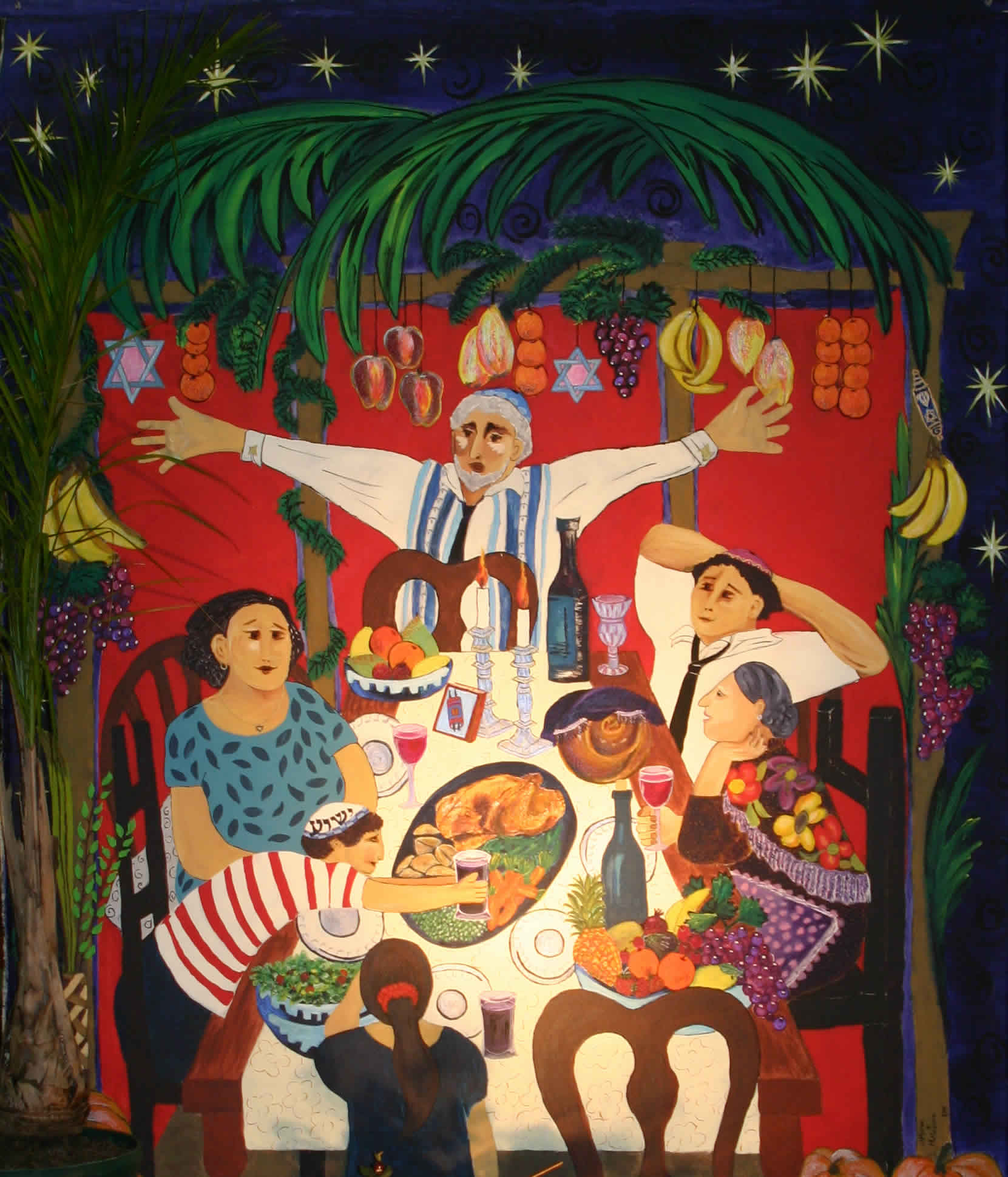
One such feast is Sukkot, the Festival of Booths. This is a ritual that has been embedded into the fabric of my family’s life and one that I intend to keep and pass on through the generations. Sukkot is a festival of celebration in which all the people live in temporary dwellings, commemorating the Israelites’ time of wandering in the desert. This feast is a celebratory holiday following Yom Kippur, the Day of Atonement.
While Sukkot does call for a citron, a date palm branch, willow twigs, and myrtle twigs, little else is needed. It is not a commercial holiday by any means of the word – its intent is to go out to celebrate with Yahweh, to reconnect with one’s creator and sustainer. The holiday is a wilderness experience, a time to celebrate the completion of atonement, of remembering God’s love for His people, whom He guided safely through the wilderness. To me, Sukkot is a time of drawing near to God and family, it is not based in gift-giving and commercialism. The feasts are going to be one ritual that can bring my loved ones together and draw each one of us nearer to God.

Thursday, November 5, 2009

"Rituals"... For Lack of a Better Title (hehe)

Rituals. There are so many everyday things we do without realizing we're doing them. We struggle to pull ourselves out of bed after subconsciously pressing the "snooze" button on our alarms. We say a quick prayer, maybe do a devotion, take a shower, get dressed, grab a quick breakfast if we're lucky, and we're off to our first class. Rituals. Where do rituals, habits and traditions become distinct? Sometimes they seem to blend together in my mind. I've heard that rituals are actions we choose to take a part in, actions that don't necessarily have a meaning behind them. Habits, on the other hand, are our subconscious actions. And traditions are meaningful actions we choose to take a part in.

Rituals, although we don't always understand them, can have a positive influence on our lives. I believe if we were to gradually turn our spiritual rituals into habits, we'd have closer walks with God. If, instead of our morning devotions being merely rituals we engaged in only because we know we should be doing them, we turned them into positive habits, maybe they would resonate more in our lives. Think about it. We'd wake up in the morning and would instinctively reach for our Bibles. This would cause great spiritual growth if we truly meditated on what God is trying to tell us and coupled scripture with prayer. Habits don't always need to have negative connotations to them, they can be positive. Such as, saying "God bless you" after hearing someone sneeze and paying tithe whenever we receive or earn money. I don't know how far we can get with rituals on their own. I'm still unsure of how they can benefit us, outside of being a comfort to us.